


Everything You Need to Know Before Buying, Using, or Servicing This Iconic 35mm Film Camera
Introduction
If you’ve been searching for answers about the Olympus Trip 35, you’re not alone.
This iconic 35mm film camera has made a huge comeback in recent years. From complete beginners to experienced photographers rediscovering film, more people than ever are asking:
- Is it worth buying?
- Does it still work after all these years?
- Why are some so cheap… and others much more expensive?
This page is designed to answer everything in one place.
Whether you’re thinking about buying your first Trip 35, comparing sellers, or trying to fix one you already own, this is your complete, no-nonsense guide.
Why the Olympus Trip 35 Is Still So Popular
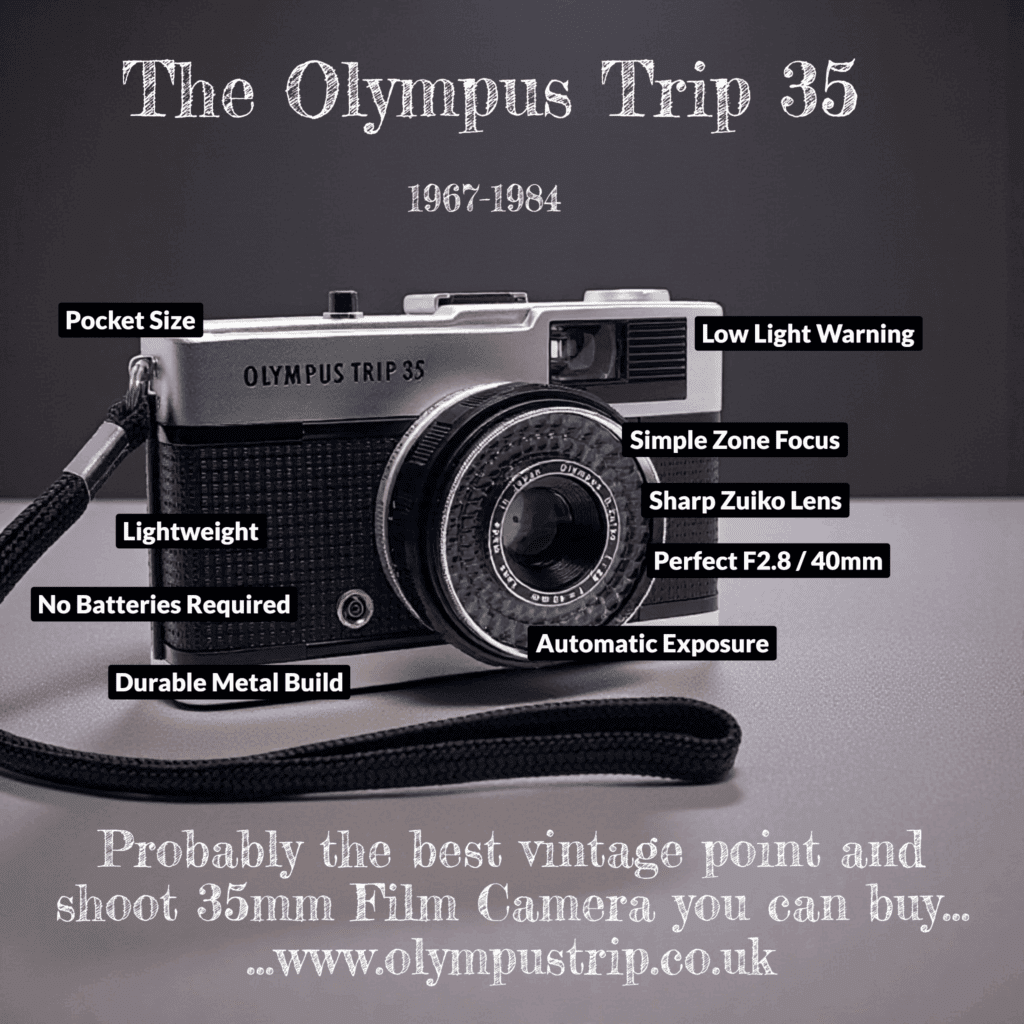
The Olympus Trip 35 isn’t just another vintage camera… it’s a perfect balance of simplicity and performance.
Released in 1967 and produced until 1984, it became one of the most successful film cameras ever made. Approximately 6.5 million Olympus rip 35’s were made.
What makes it special?
- Fully automatic exposure
- No batteries required (ever)
- Sharp Zuiko 40mm f/2.8 lens
- Compact, durable metal body
- Designed for everyday use and travel
It was built for simplicity… and that’s exactly why it’s still loved today.
Buying an Olympus Trip 35 (What You Need to Know)
Is it worth buying?
Yes… if you want a camera that just works and helps you enjoy photography again. It has a huge following and has achieved iconic status as a vintage film camera.
Why are some so cheap?
Because many are:
- Untested and probably broken or damaged
- Unserviced and probably not capable of decent photographs
- Unloved as some people think that film photography is dead – which it is not.
They may look great… but internally they often aren’t.
Here’s a handy Olympus Trip 35 Buyers Guide – https://olympustrip.co.uk/the-olympus-trip-buyers-guide/
Why are serviced cameras more expensive?
Because they’ve been:
- Fully stripped, checked and replacement parts fitted
- Cleaned and adjusted
- Function Tested
- Come with a returns policy and peace of mind warranty… well they do with me.
👉 That’s the difference between a display piece and a working camera.
How the Olympus Trip 35 Works
The Trip 35 is brilliantly simple.
Key features:
- Automatic exposure (point and shoot)
- Selenium light meter (no batteries)
- Two shutter speeds: 1/40 and 1/200
- Aperture range: f/2.8 to f/22
- ISO range: 25–400
You set:
- Film speed (ISO)
- Focus (zone icons) – there are only four settings and one default that works in most situations
…and the camera does the rest.
The “Red Flag” Explained
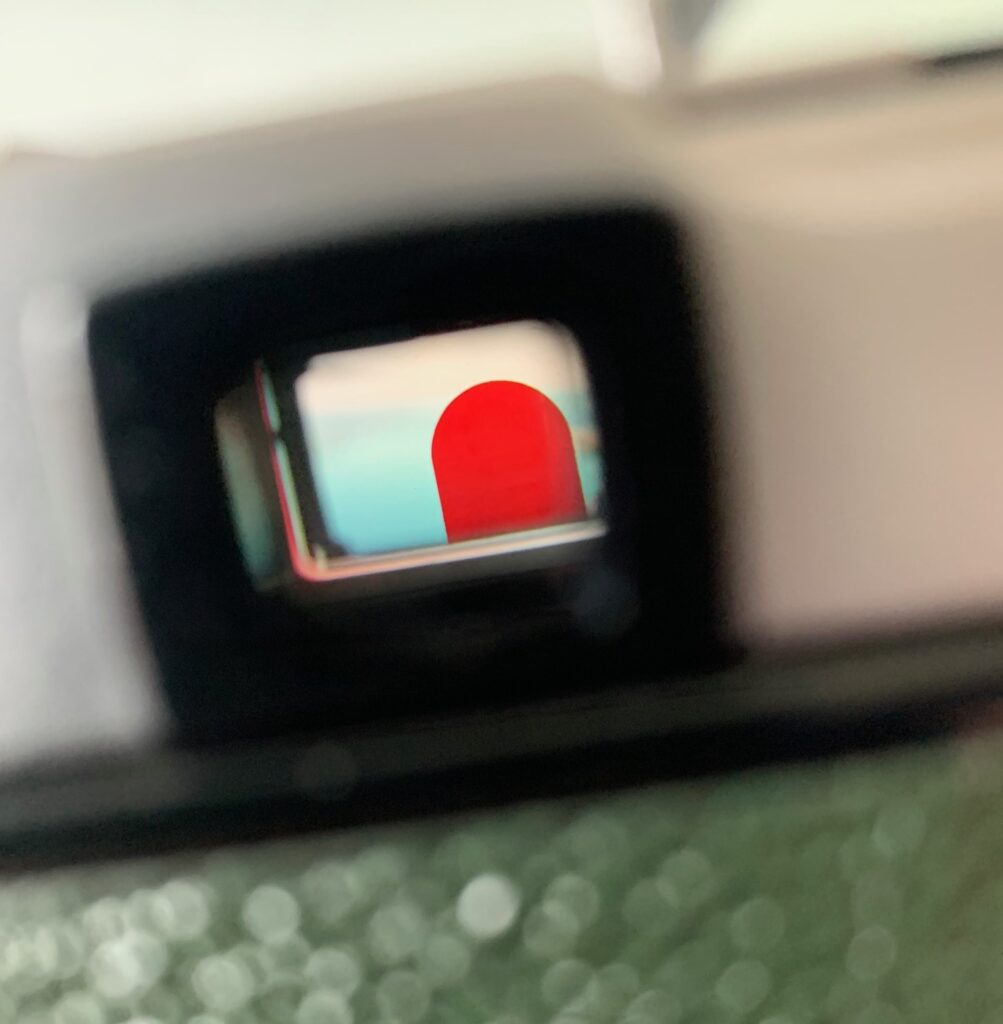
One of the most talked-about features is the red flag warning system.
What does it do?
- Pops up in low light
- Locks the shutter
- Prevents underexposed photos
Why it matters:
Film isn’t free… so this feature saves wasted shots.
Common issue:
On older cameras, the red flag can:
- Stick
- Fail to trigger
- Be linked to other internal faults
👉 If it’s not working properly, the camera likely needs servicing.
Film Photography Is Not Dead (Far From It)
Despite what people say, 35mm film photography is thriving.
You can still easily:
- Buy film online (Kodak, Ilford, Fujifilm)
- Get film developed (mail-in labs or local drop-in or develop yourself)
- Scan to digital or print
Film today is actually:
- More accessible
- Better supported
- More appreciated than it was just before digital took over.
- More varied in styles and effects it can achieve
Using the Olympus Trip 35 (Beginner Friendly)
What film should you use?
Start with:
- ISO 200 (daylight)
- ISO 400 (general use)
Popular choices:
- Kodak Gold 200
- Ilford HP5 400
- Fomopan 400 (good budget film)
How to shoot:
- Load film
- Set ISO
- Set focus (zone icons)
- Shoot in “A” mode
That’s it.
Common Problems (And Why They Happen)
Most Trip 35 issues come from age and inactivity, not poor design.
Typical faults:
- Sticky aperture blades from periods of long storage / dirt in camera
- Weak or inconsistent exposure from poor light meters
- Dirty lens elements and fungus / haze on the lens
- Worn light seals – quite common
- Non-working red flag – as mentioned
👉 Important:
A camera can look perfect externally and still have all of these problems internally.
Servicing vs “Working Condition”
This is where most buyers get caught out.
“Working” usually means:
- It fires.
- Film advances
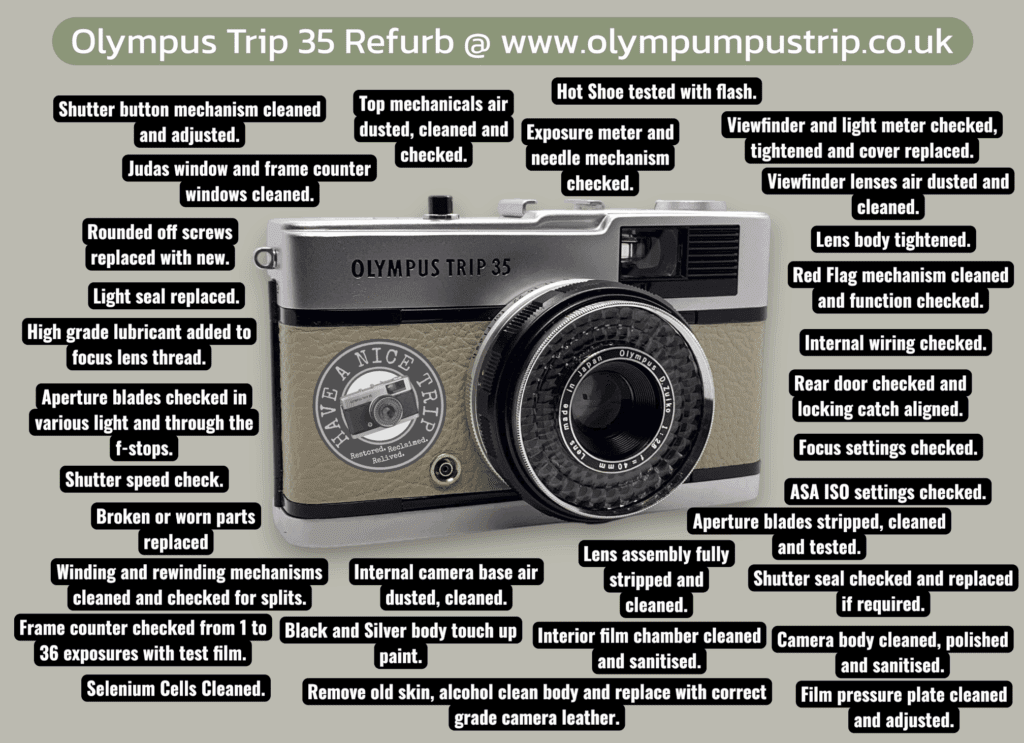
Properly serviced means:
- Clean internals and optics
- Accurate exposure and shutter / aperture blade movement
- Reliable performance depending on light
- Ready for long-term use and durable
👉 Big difference.
In fact – there’s a lot more to a a Have A Nice Trip service than that – just look at our servicing checklist…
Why Buy a Serviced Olympus Trip 35?
Because it removes the gamble.
Benefits:
- Consistent results
- No hidden faults
- Longer lifespan
- Better overall experience
It’s the difference between:
👉 Testing a camera
👉 and actually enjoying it
Accessories That Make a Difference
To get the most out of your Trip 35:
Recommended:
- UV filter → protects lens + improves clarity
- Flash unit → for low light
- Protective pouch → for travel
- Wrist strap → safer handling
- Lens Cap – protect the selenium light cells / meter
These small additions:
👉 Protect your camera
👉 Improve usability
👉 Extend lifespan
Visit our Olympus Trip 35 Parts Shop here – https://olympustrip.co.uk/product-category/olympus-trip-35-spare-parts/
Olympus Trip 35 FAQ (Top Questions Received)
Below are the most common questions about the Olympus Trip 35 I receice and see online in social media and chat forums.
📸 Buying & Value
Is the Olympus Trip 35 worth buying?
Yes. It’s reliable, simple, and produces excellent results.
Why is it so popular?
Because it combines ease of use with high-quality optics and excellent build quality.
How much should I pay?
£120–£250 for a fully serviced model with warranty.
Are cheap ones worth it?
Only if you’re willing to take a risk.
⚙️ Features
Does it need batteries?
No.
Is it automatic?
Yes… fully in Auto mode. (A)
What lens does it use?
40mm f/2.8 Zuiko. A brilliant lens that was used on much more expensive Olympus cameras.
🎞️ Film & Shooting
What film should I use?
ISO 200–400 is ideal and widely available.
Can it shoot at night?
Confidently with flash… and carefully without for night street life shots etc.
What is the red flag?
A low-light warning system. Stops you taking underexposed shots.
🛠️ Repairs
Do they need servicing?
Yes…most do if they have not been used for a long time or are not film tested.
Can I fix one myself?
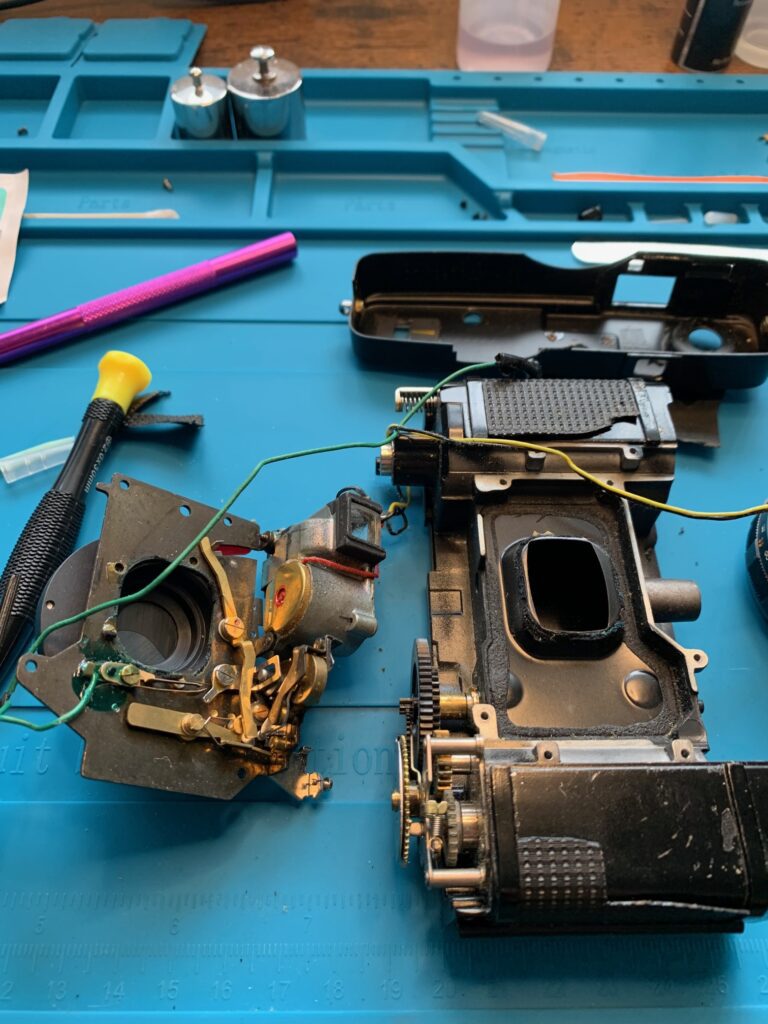
Basic fixes, yes. Full servicing, more complex. Opening up a Trip 35 is not for the feint hearted.
🌍 Film Photography
Is film still available?
Yes… widely. Just Google and see.
Is film photography coming back?
Yes…and growing fast.
🎯 Ownership
How long do they last?
Decades if maintained and have been properly serviced.
Is it a good gift?
Yes… unique and meaningful. Many of my cameras are sold as gifts.
Final Thoughts
The Olympus Trip 35 isn’t just a camera.
It’s:
- A slower way to see the world
- A more intentional way to capture it
- A connection between past and present
And when properly serviced… it’s still one of the most enjoyable cameras you can own.
Ready to Start Your Film Photography Journey?
If you’re looking for a fully serviced Olympus Trip 35, ready to shoot straight out of the box:
👉 Visit: www.olympustrip.co.uk
Each camera is:
- Carefully restored, repaired and serviced.
- Fully function tested
- Backed by warranty and ongoing customer support long after the warranty has expired.
Because you’re not just buying a camera… you’re starting a new way of seeing the world.
For more information, blogs and guides – read our Ultimate Guide to the Olympus Trip 35 here: